How to Tell if School Shoes Are Genuine Leather: 9 Simple Checks
When parents are told that a pair of school shoes is made from leather, it is reasonable to want to know exactly what they are buying.
The term “leather” can sometimes be used loosely in footwear descriptions, so understanding basic material clues can help consumers make better purchasing decisions.
If you’re wondering how to tell if school shoes are genuine leather, there are several things you can examine.
No single home test is perfect, but combining multiple clues can give you a better idea.
What Is Genuine Leather?
Genuine leather means the material is derived from animal hide rather than being entirely synthetic.
However, the term itself does not necessarily tell you the exact grade or quality.
Leather can be processed and finished in different ways.
Therefore, parents should consider both:
Material authenticity + construction quality
A genuine leather upper can still be poorly constructed, while a well-made synthetic shoe may be suitable for some uses.
ALSO READ: How to Buy School Shoes Online and Pay with M-Pesa
1. Read the Product Description Carefully
The first place to start is the manufacturer’s or seller’s product information.
Look for clear wording about:
- Upper material
- Lining
- Sole
- Country of manufacture
- Leather type
- Product specifications
Be cautious when descriptions use vague phrases such as “leather style” without explaining the material.
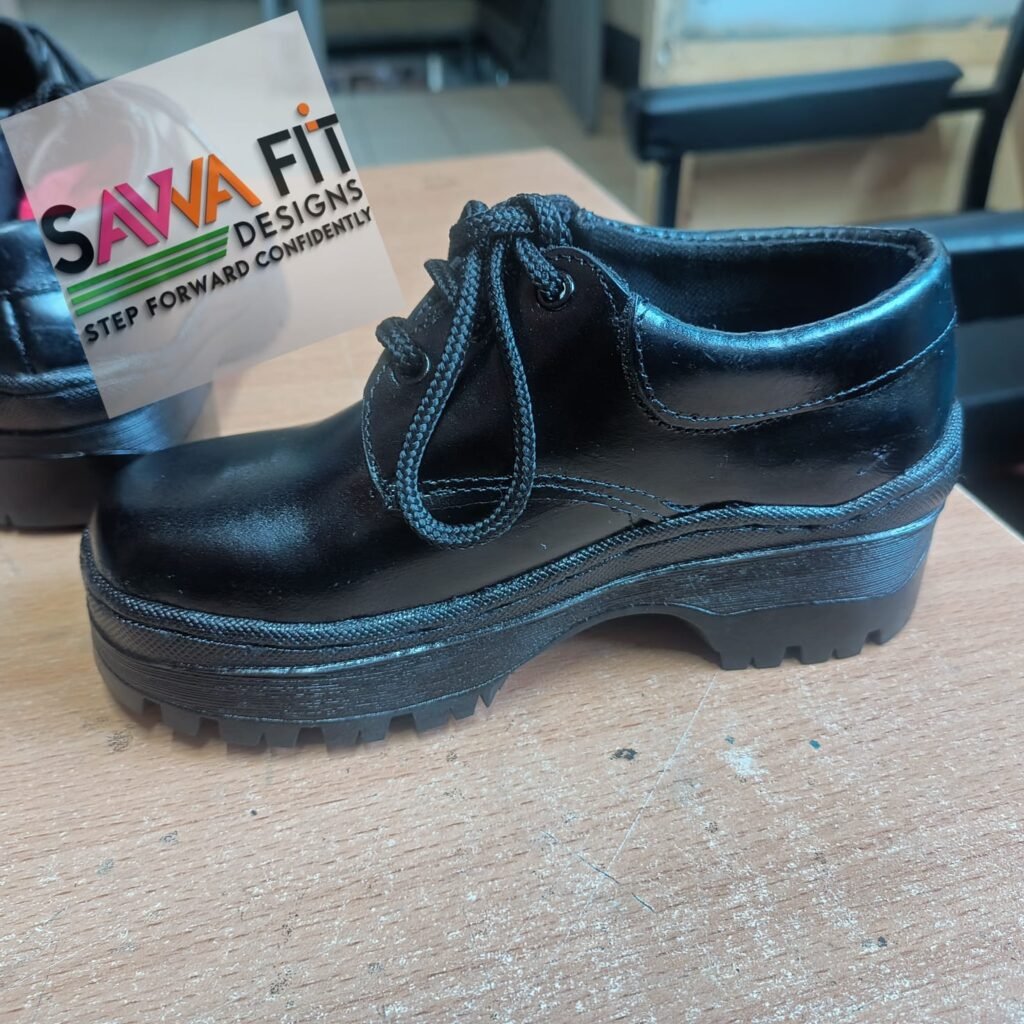
SAWA FIT’s product pages explicitly identify several of its school shoes as genuine leather and describe their construction, including leather uppers and rubber soles.
2. Examine the Texture
Natural leather often has a less perfectly uniform surface than plastic-based materials.
You may see subtle variations in:
- Grain
- Texture
- Pores
- Wrinkles
However, don’t assume that perfectly smooth leather is automatically fake.
Leather can be heavily finished or embossed.
Texture is therefore a clue, not definitive proof.
3. Look at How the Material Creases
Bend the shoe gently if the design allows.
Leather generally develops natural-looking creases as it bends.
Some synthetic materials may produce a different type of uniform crease.
Again, this is not a laboratory test.
It should be combined with other observations.
4. Check the Edges
Look carefully at exposed edges around the material.
Genuine leather and synthetic materials can have different edge characteristics, but modern manufacturing techniques make visual identification difficult in some cases.
This is why buying from a transparent manufacturer or established retailer can be more reliable than trying to perform a single “test.”
5. Smell the Material Carefully
Leather often has a distinctive natural smell.
Synthetic materials can smell more like plastic or chemicals.
But smell alone is not reliable.
Manufacturers can add fragrances, finishes and treatments.
Never use a smell test as the only basis for determining authenticity.
6. Examine the Construction
Don’t focus only on the upper.
Look at:
- Stitching
- Sole attachment
- Heel construction
- Lining
- Footbed
- Closure
- Overall finishing
A quality school shoe should have consistent construction.
A genuine leather upper does not automatically make the entire shoe high quality.
7. Check the Product Label
If purchasing from a physical retailer, inspect labels and packaging.
Look for:
- Material information
- Manufacturer details
- Product identification
- Care instructions
If purchasing online, look for detailed specifications rather than relying on photographs alone.
8. Be Suspicious of Unusually Vague Claims
A seller may say:
“Premium leather.”
But what does that actually mean?
Ask questions.
For example:
- Is the upper genuine leather?
- What material is the lining?
- What is the sole made from?
- Where is the shoe manufactured?
- Is the leather used throughout the upper?
Transparent answers are generally preferable to vague marketing language.
9. Consider Who Made the Shoe
Purchasing from an established manufacturer or retailer can reduce uncertainty.
SAWA FIT identifies its leather school shoes as locally handcrafted and provides specific material and construction information on its product pages.
That type of product information is useful because parents don’t have to rely entirely on visual inspection.
Genuine Leather vs Synthetic: Quick Comparison
| Feature | Genuine leather | Synthetic material |
|---|---|---|
| Origin | Animal hide | Manufactured material |
| Natural grain | Often present | Usually manufactured |
| Breathability | Often good | Varies |
| Durability | Can be high | Varies significantly |
| Maintenance | Requires care | Often easier |
| Appearance | Can develop character | Usually more uniform |
| Price | Often higher | Often lower |
These are general characteristics, not guarantees.
Quality varies considerably within both categories.
Should Parents Perform a Burn Test?
No.
You may find online advice recommending heat or flame tests.
This is not appropriate for ordinary consumers.
It can damage the shoe, create dangerous fumes and cause burns or fire.
There is no reason to risk injury simply to test a school shoe.
What About the Price?
Price can sometimes provide a clue, but it does not prove material authenticity.
An unusually cheap shoe may warrant additional questions, but expensive shoes are not automatically genuine leather.
Look at:
Material + construction + seller transparency + product information + price
together.
Why Does Genuine Leather Matter for School Shoes?
Parents often choose leather because they want a combination of:
- Durability
- Classic appearance
- Comfort
- Structure
- Long-term value
SAWA FIT’s leather school shoes are marketed around durability, comfort and everyday school use, with protective uppers and durable soles.
However, parents should remember that a leather shoe still needs correct sizing and maintenance.
Final Thoughts
Learning how to identify genuine leather school shoes can help parents make more informed purchasing decisions.
Instead of relying on one internet “hack,” consider several factors:
- Read the product description.
- Check the stated material.
- Examine texture.
- Look at the creasing.
- Inspect construction.
- Check labels.
- Ask the seller questions.
- Avoid dangerous tests.
- Buy from transparent and established sellers.
For parents looking for genuine leather school footwear, clear product specifications are often more valuable than trying to become a leather expert overnight.
Related Articles: What Are the Best School Shoes for Kindergarten Children?